
Integrate in 48 hours, pay back in 4 months
How a plug-and-play pilot at Mile Hi Foods delivered 11% average throughput gains on the infrastructure they already had
May 2026

Most people wouldn't expect this.
Warehouse pickers working hands-free, with the next pick showing right in their field of view - after a 48-hour integration.
Not after a months-long rollout.
Not after reconfiguring the WMS.
Not after rebuilding the workflow from the ground up.
Two days. Then picking, hands-free.
This isn't a story about custom integration. It's a story about plug-and-play technology that works with the industry-standard hardware and software warehouses already run on - and what becomes possible when the cost of trying something new is barely a cost at all.
"The teams really enjoyed trying your solution and trying something new. I know that's not common in our environment. So everyone's really taken to it."
Brian Evans - Director Continuous Improvement, Mile Hi Foods
The environment
Mile Hi Foods runs a high-volume distribution operation serving one of the country's largest quick-service restaurant networks - an environment where throughput, accuracy, and uptime are measured against peers daily, and where any change to the floor has to clear a high bar before it goes live.
Like most operations at this scale, their pick workflow ran on Ivanti Velocity - proven, tuned, and serving terminal emulation and browser-based picking on the handhelds the team already knew. The associates were experienced. The workflow was set. There was nothing about the existing system that needed fixing.
So the question wasn't whether the underlying environment worked. It clearly did. The question was whether anything new could be added without disturbing it.
The usual answer - and a different one
In most distribution operations, "adding new hardware" is shorthand for a multi-month project. Software integrations. WMS changes. Device certifications. Training plans. Before the first pick happens through the new system, a quarter has gone by.
That's the cost most teams quietly accept as the price of trying something new. And it's the reason a lot of "something new" never gets tried at all.
But because Six15's ST1 Bluetooth® HUD is plug-and-play with the industry-standard infrastructure Mile Hi already ran on - Ivanti Velocity, Zebra Android handhelds, ring scanners - the integration looked nothing like that.
Same Ivanti environment. Same workflow. Same handhelds. Same WMS. Just a different way of seeing the instructions.
The mental model that fits best isn't a software project. It's pairing wireless headphones to a smartphone. The phone doesn't change. The apps don't change. But the experience changes - and what you can do with the same device expands, because your hands are free and your attention is free. The ST1 HUD pairs to a Velocity environment the same way.
The integration itself took 48 hours of work at Mile Hi. Calendar time ran to about two weeks - most of that spent coordinating schedules and getting the right people on a call.
The pick workflow didn't change. What changed was the display. Rather than mirroring the handheld screen, the ST1 surfaces only the essentials of each pick-location, item, quantity - in the user's field of view. That's a deliberate design choice, borrowed from neuroscience: for rapid, repetitive work, less on-screen information produces faster and more accurate decisions than more. What the user sees is what the user needs, and nothing else.
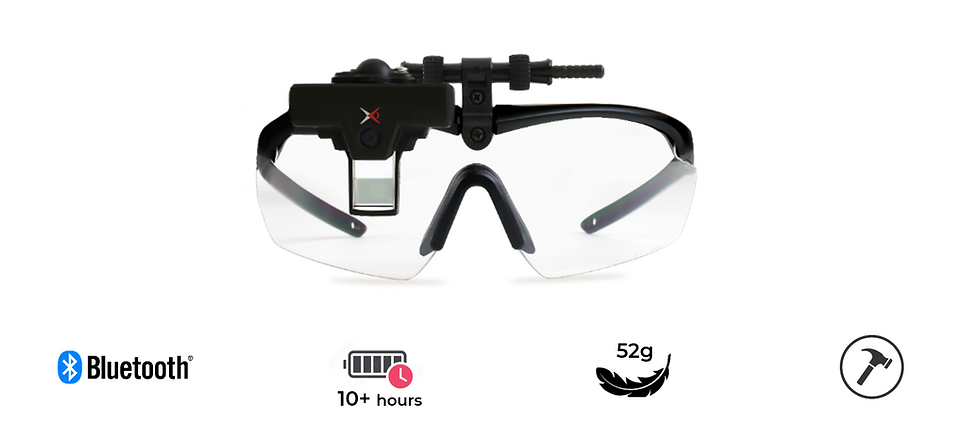
Pair the HUD, attach the ring scanner, and start picking. No middleware rewrite. No host-side change. No new pick logic to learn.
How users adapted
The thing that matters most with new floor technology isn't whether it works in a lab. It's whether the people who use it every day take to it. With ST1, they did.
Some users took to it immediately. One was indifferent. And one was the kind of operator who doesn't volunteer enthusiasm even when he feels it.
"He wasn't going to give you gushing reviews. But I could tell he really did like the faster speed."
Ron Vega - Warehouse Manager, Mile Hi Foods
That mix - genuine enthusiasm, quiet conversion, one holdout - is what natural adaptation looks like. What it isn't is a months-long change-management exercise.
What actually happened
Once the team settled in, the throughput data spoke for itself.
Across the pilot group, the team's average hourly pick rate rose 11% over baseline - measured over a steady-state window of roughly seven weeks. Every operator on the pilot landed above their own starting point.
The more striking pattern, in fact, wasn't the average. It was where the gains landed. The biggest lifts - as much as 25% - went to the operators who had been picking the slowest, pulling them within a few picks per hour of the team's top performers. The whole team got faster, and the gap between the fastest and the slowest pickers narrowed sharply at the same time.
Accuracy held steady. The pilot didn't move it - but in an environment where controllable accuracy was already at 99.97%+, there wasn't much room to move it. The throughput gain came with no accuracy trade.
From the person who ran the analysis:
"My job is to figure out what's actually improving the operation, and what just looks like it is. On this pilot, we measured per-operator, day by day, and isolated for the variables we could control. What came out wasn't a story we needed to tell—it was just what the data showed: an 11% productivity gain, with the biggest lifts going to the people who'd been picking the slowest. Numbers like that don't show up by accident."
Neil Henry - Continuous Process Improvement Lead, Mile Hi Foods
And the broader leadership read matched it:
"I remember putting the headset on at Modex a couple of years ago, thinking, yeah, this would definitely make everybody much, much faster. It's cool to see those translate into roughly 11% across the board."
Brian Evans - Director Continuous Improvement, Mile Hi Foods
Why it worked
Before, every pick cycle required a small reset: glance down at the handheld, read the next location and item, look back up, move, scan, repeat.
After, those interruptions were gone. The same instructions—from the same Ivanti Velocity environment - simply appeared in the user's field of view. Hands stayed free. Movement stayed continuous.
The cognitive cost of switching between the device and the work dropped to near zero.
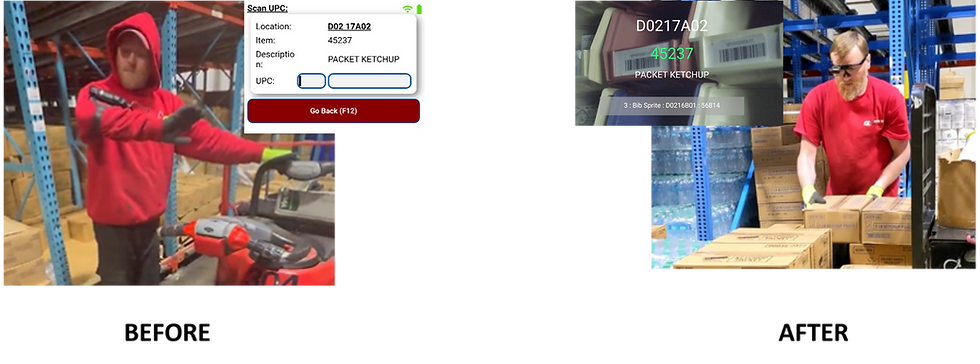
The underlying system didn't change. The way the team experienced it did.
And because the integration took 48 hours instead of months, none of that change-management cost stacked on top of the gains. The pilot didn't need to "earn back" a long rollout before delivering value. It delivered value almost as soon as it started.
The financial reality
An 11% gain compounds quickly when there's nothing slowing it down.
Per user: about $370 in monthly productivity savings - translating to a 4-month payback on the initial investment, and roughly $4,340 in annual savings per user thereafter.
At a 30-user deployment, that's over $130,000 in annual savings, still at the same 4-month payback.
And on the capacity side: an 11% pick-rate gain at Mile Hi's average selling price is worth roughly $2 million in additional annual capacity per operator - on the same floor, with no new square footage required.
Pilot conducted January–April 2026. Performance figures reflect the steady-state window. Full methodology available on request.
What this actually changes
Most operations treat "trying new technology" as a major decision - because historically, it has been. The cost isn't just the hardware. It's the months of integration, the retraining, the disruption to a workflow that already mostly works.
Mile Hi's pilot reframes that math.
No multi-month integration.
No WMS reconfiguration.
No new workflow to learn.
When new technology is plug-and-play with the industry-standard infrastructure operations already run on - as ST1 is with Ivanti Velocity - the cost of trying drops. And when the cost of trying drops, the question changes shape entirely.
"What I like about the Mile Hi pilot is how unremarkable the integration was. No host changes. No workflow rewrite. Just a hands-free way to do the same picking, with real productivity gains to show for it. That's exactly what we built Velocity to do - be the platform that lets companies bring modern technology into the infrastructure they already rely on, without ripping anything out. Six15 is a great example of it working."
Greg Berger - Director, Partner Sales, Ivanti
For any operation watching this from the outside, that's the shift that matters.
It stops being, "Is this worth a quarter of disruption?"
And starts being, "With gains like these on the other side of a 48-hour integration, what's the case for not running the pilot?"
Not whether it works.
But how soon could you see what it does in your environment?
