
Near-zero learning curve, 11% more picks
How immediate usability unlocked step-change performance at Palmer Food Services
June 2026

Most people wouldn't expect this.
An 11% increase in pick rates - within the first three weeks of using the technology.
Not after months of training.
Not after a productivity dip.
Not after the team finally adjusted.
Almost right away.
This isn't a story about a rollout. It's a story about what happens when there's almost nothing to roll out - and what that absence of friction unlocks at every layer of the operation.
Here's how one of the associates using it put it:
"I was skeptical. But after a few days I didn't want to go back to the old way. Your hands are free; you're not stopping and starting as much. It just flows better."
Associate - Palmer Food Services
The environment
Palmer Food Services runs a high-volume distribution operation where pick rate is one of the most closely watched numbers on the floor. The workflows were already established. The systems were proven. The team knew what they were doing.
In environments like this, performance doesn't stall because of effort. It slows in the small moments between steps - the glance down at a handheld, the pause to confirm, the reset before moving again. Each one feels insignificant. Across a shift, they add up.
So the question wasn't how to redesign the process. It was how to move through it faster, without adding complexity.
A different question entirely
Most performance technology comes with a familiar pattern. Before the gains show up, there's a period of adjustment. Users learn something new. Supervisors reinforce it. Productivity dips before it climbs.
Even when the long-term outcome is positive, that initial friction is real - and in many operations, it's enough to slow adoption or limit scale.
So the question shifted.
Not how to improve performance - but whether it was possible to improve it without a learning curve at all.
What the team prepared for
When Six15's ST1 Bluetooth® HUD was brought in, the operations team did what good operations teams do. They planned for a ramp. They built in time for associates to get comfortable. They prepared supervisors to reinforce the new process. They expected the usual dip before the climb.
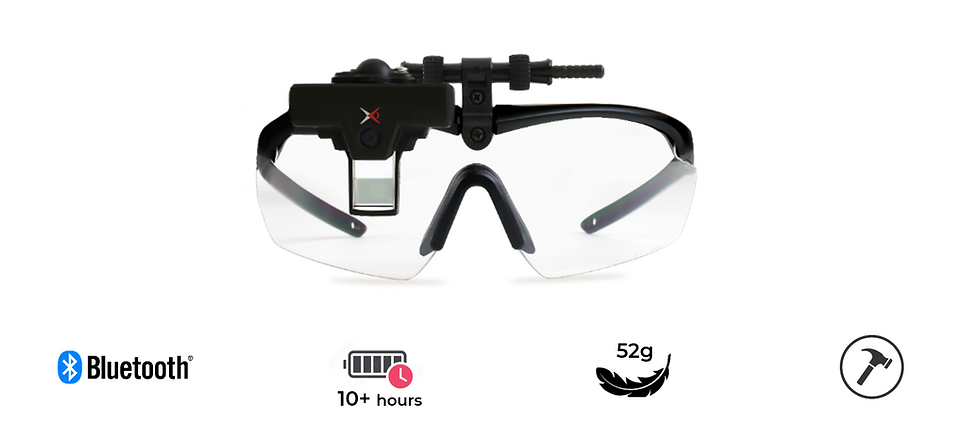
The premise of the technology was simple: don't change the workflow - change how it's experienced. Instead of looking down at a handheld, instructions appeared in the user's line of sight. Paired with a ring scanner, picking became hands-free. The underlying system stayed exactly the same.
"It was easy to integrate with existing software and hardware technology with no changes to the existing ERP/WMS systems."
Rich Riedman - VAR, Riedman Communications
Same system. Same workflow. Same work. Just a different way of interacting with it.
None of that explained what actually happened next.
What actually happened
The associates picked it up in minutes.
There was no extended onboarding. No "figuring it out." From the first exposure, users recognized the benefit - less time looking down, fewer interruptions, a more natural way of working. What typically takes days or weeks to internalize simply didn't apply.
And the numbers followed immediately. Across the pilot group, average pick rates rose 11% - measured against each operator's own historical baseline. Not a spike. Not an isolated outcome. Consistent, repeatable improvement, starting in the first three weeks of use.
The dip everyone had budgeted for never arrived.
Supervisors who had blocked time to reinforce the new process found there wasn't much to reinforce. Trainers who had planned ramp-up sessions found new users productive almost immediately. The entire scaffolding built around "managing the rollout" turned out to be unnecessary.
Even the associates who started out skeptical - like the one quoted earlier - came around within days. Not because they were convinced to. Because the work simply got easier.
It wasn't dramatic. That was the point. And here's how Palmer's leadership described what they saw:
"We've seen a lot of technology come through our operation. What stood out here wasn't just the 11% improvement in pick rates - it was that we saw within the first three weeks. No long ramp, no retraining, no disruption to the floor. Just a better way of doing the same work."
Christopher Wiedemann - Continuous Improvement Strategist, Palmer Food Services
Why it worked
Before, every pick cycle required a small reset: a glance down, a moment to process, a shift in focus before moving again.
After, those interruptions were gone. Instructions stayed in view. Hands stayed free. Movement became continuous instead of stop-and-go.
But the more important shift wasn't physical - it was cognitive. There was nothing new to remember. No new process to follow. No additional layer to manage. The system aligned with how the work was already being done, which meant users could focus entirely on the task itself.
That's what removed the learning curve. Not training. Not reinforcement. The fact that there was nothing extra to learn.

The financial reality
An 11% improvement adds up fast - and in this case, it added up almost immediately.
For a single associate on an 8-hour shift, that's roughly an extra 50 minutes of productive work every day - about $4,500 a year at a typical wage rate.
Scale that to a 30-user deployment and you're past $135,000 a year, with payback in about five months.
And because there was no long ramp, value started accruing almost right away - not after the team got up to speed.
What this actually changes
Most operations assume that improvement requires time. Time to train. Time to adapt. Time to see results. The cost of a new technology isn't just the technology - it's the rollout that surrounds it.
Palmer's experience challenges that assumption.
No extended onboarding.
No productivity dip.
No months long ramp to value.
When a system is intuitive enough to be used immediately, the entire timeline shifts. Performance gains stop being something you wait for and start being something you realize almost right away.
Which means the barrier to an 11% gain isn't complexity, or training, or change management. It's simply the decision to start.
Not whether it works.
But how long does it make sense to operate without it?
